
In October 2026, courts on both sides of the Atlantic returned to the aftermath of two of the worst oil spills in history. In the United States, the Fifth Circuit addressed what evidence a cleanup worker needs to establish a link between the worsening of his medical condition and his exposure to oil and dispersants during the response to the 2010 Deepwater Horizon disaster. In the United Kingdom, the Supreme Court delivered its ruling in the litigation arising from the 2002 sinking of the tanker Prestige, which polluted the coastlines of Spain and France. The Fifth Circuit also decided two other cases: it considered whether a contract qualified as maritime and revived a vessel owner’s claims alleging that its broker failed to remit charter hire. In the United Kingdom, a reform of the High Court came into effect, and the Commercial Court showed the powerful effect of a so-called “hell-or-high-water” clause. Summaries of these developments follow below.
No Maritime Contract, No Indemnity: Fifth Circuit Holds That Using Vessels to Transport Workers to Oil Platforms Does Not Make a Contract Maritime
In re Complaint of Whitney Oil & Gas, L.L.C., No. 25-30560, 2026 WL 3150785 (5th Cir. Oct. 21, 2026)
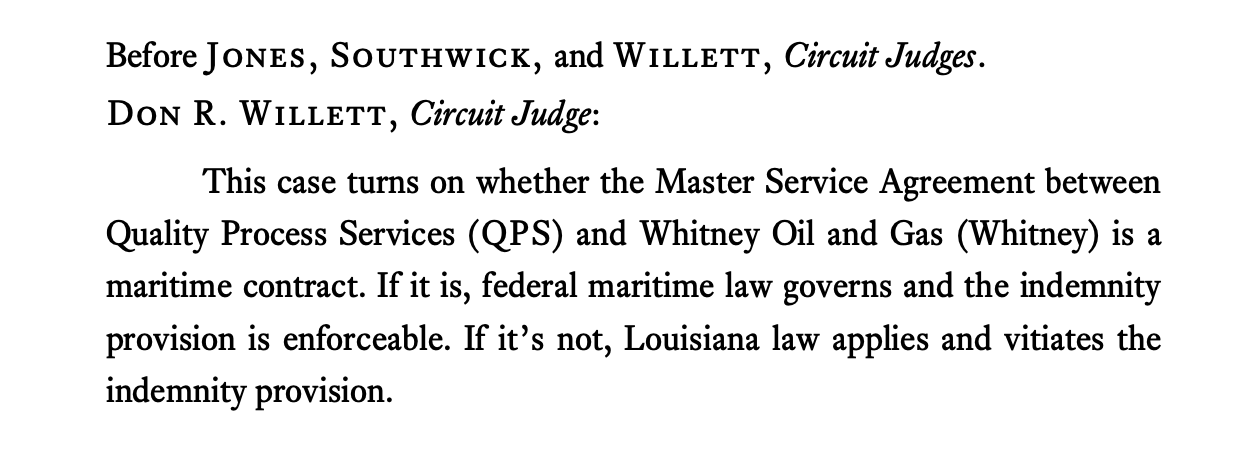
The case turned on whether a master service agreement between an oil and gas producer (Whitney Oil & Gas, LLC) and its contractor (Quality Process Services, LLC) was a maritime contract. If so, federal maritime law would govern, and the indemnity provision would be enforceable. If not, Louisiana law would apply and render the indemnity provision void.
Under the agreement, the contractor supplied contract laborers, most of them production operators, to work on the producer’s platforms off the Louisiana coast. The operators traveled by vessel to the platforms, where they disembarked to read gauges, check pipes, and monitor well flow. The agreement required the producer to defend and indemnify the contractor against claims for injuries to the producer’s employees.
After Hurricane Ida, an employee of the contractor was piloting the producer’s vessel to a work platform, carrying an employee of the producer, when the vessel allided with a well jacket. The producer’s employee was seriously injured and sued both the contractor and the producer. The contractor, in turn, sought indemnity from the producer under the agreement. The district court dismissed the indemnity claim, holding that the agreement was not maritime and that the indemnity provision was void under the Louisiana Oilfield Anti-Indemnity Act.
The U.S. Court of Appeals for the Fifth Circuit affirmed. Under In re Larry Doiron, Inc., 879 F.3d 568 (5th Cir. 2018) (en banc), a contract is maritime if (1) it is a contract to provide services that facilitate the drilling or production of oil and gas on navigable waters and (2) the contract provides, or the parties expect, that a vessel will play a substantial role in its completion. Only the second prong was disputed. The court agreed with the district court that the agreement was unclear as to whether a vessel would play a substantial role in its completion. Turning to the parties’ expectations, the court found that the contractor’s employees were expected to drive the vessels only to get to the platforms, which was incidental to the non-maritime work the contractor was hired to perform. Having found that vessels were not expected to play a substantial role in completing the contract, the court held that the agreement was not maritime.
Takeaway: This decision continues the Fifth Circuit’s line of post-Doiron cases holding that vessels used merely to transport workers to a platform do not play a substantial role in completing the contract and therefore do not make it maritime. See, e.g., Offshore Oil Services, Inc. v. Island Operating Co., Inc., 150 F.4th 677 (5th Cir. 2025); Genesis Energy, L.P. v. Danos, L.L.C., 152 F.4th 648 (5th Cir. 2025). Its principal contribution is the refusal to distinguish between scenarios in which vessels are operated by a third party and those in which they are operated by the contractor’s own workers, as was the case here. Under this opinion, piloting a vessel to the work site remains transportation, and transportation does not satisfy the substantial-role requirement.
Read the court’s opinion here.
P.S. It is worth noting how Judge Willett opens the opinion. In just three sentences, he tells the reader the question and the two possible outcomes, depending on how it is answered. This sets the context for everything that follows.
Deepwater Horizon Litigation: Cleanup Worker Loses on Causation Under Maritime Law
DuFour v. BP Exploration & Production, Inc., No. 23-60361, 2026 WL 3215980 (5th Cir. Oct. 27, 2026)
Richard DuFour, Jr., worked for almost three years as a cleanup worker after the 2010 Deepwater Horizon oil spill. He alleged that exposure to crude oil and chemical dispersants caused chronic worsening of his asthma. He sued BP under the Back-End Litigation Option (BELO) of the Deepwater Horizon Medical Benefits Class Action Settlement Agreement,1The Back-End Litigation Option (BELO) is a mechanism created by the Deepwater Horizon Medical Benefits Class Action Settlement Agreement for class members whose conditions were diagnosed too late to qualify for a settlement payment. Instead, these claimants may file individual lawsuits against BP to recover compensatory damages resulting from a “Later-Manifested Physical Condition.” Among the issues that may be litigated in a BELO suit is whether the class member’s condition was legally caused by exposure to oil, dispersants, or decontaminants used in connection with the Deepwater Horizon response activities. which required him to prove that his injuries were legally caused by exposure to substances during response efforts. To establish causation, he relied on two experts. The district court excluded their testimony and granted summary judgment to BP.
The U.S. Court of Appeals for the Fifth Circuit affirmed. The court relied, inter alia, on its unpublished decision in Seaman v. Seacor Marine L.L.C., 326 F. App’x 721 (5th Cir. 2009), under which a plaintiff in a toxic tort case must establish through expert testimony (1) scientific knowledge of the harmful level of exposure to a chemical and (2) knowledge that the plaintiff was exposed to such quantities. Reviewing for abuse of discretion, the court upheld the exclusion of both experts’ testimony because neither reliably connected DuFour’s exposure to the worsening of his preexisting asthma. For example, one expert relied primarily on a study that excluded workers with preexisting asthma, such as DuFour, and examined only the risk of developing the condition, not its worsening. Having agreed with the district court that neither expert’s testimony was admissible, the Fifth Circuit affirmed summary judgment in favor of BP.
A Point to Watch: Interestingly, the majority applied general maritime law, as both parties contended it should, and held that toxic tort causation principles form part of it, either because a body of judicial decisions sufficed to establish that maritime rule or because federal courts, at least in the Fifth, Second, and Eleventh Circuits, had created it. In support, it relied on Great Lakes Insurance SE v. Raiders Retreat Realty Co., 601 U.S. 65 (2024), which recognized that “a body of judicial decisions can suffice” to establish a federal maritime rule and that “[i]n the absence of an established rule, federal courts may create uniform maritime rules.”
Judge Oldham, however, questioned whether maritime law governed DuFour’s claim, for three reasons: (1) the exercise of admiralty jurisdiction “does not result in automatic displacement of state law”; (2) the choice-of-law clause in the Medical Benefits Class Action Settlement Agreement selected general maritime law only for the “interpretation” of the agreement and release, not to govern BELO litigation; and (3) the parties’ shared position on the applicable law did not bind the court. Judge Oldham was not persuaded that the majority had settled which law applies. The question may resurface in a future BELO case, especially if the parties disagree on the governing law.
Read the court’s opinion here.
Unpaid Charter Hire: Vessel Owner’s Claims Against Broker Head Back to District Court
SEACOR Marine, L.L.C. v. GOL, L.L.C., No. 26-30021, 2026 WL 3082498 (5th Cir. Oct. 15, 2026)
A vessel owner appointed a broker as its agent for chartering its vessels, requiring the broker to remit any charter hire it received, less its brokerage fee. The broker chartered the owner’s vessels to an oil and gas exploration and production company (the producer), which failed to pay $2.7 million in charter hire and filed for bankruptcy. The broker filed a claim in the bankruptcy court against the producer for approximately $24.8 million, which included the $2.7 million in charter hire owed to the owner.
With the bankruptcy court’s approval, the producer agreed to pay the broker $13 million toward that claim in exchange for the broker’s continued services. The broker paid the owner nothing, distributing most of the money to itself and companies owned by its co-owners. The owner sued the broker for breach of contract and breach of fiduciary duty. The district court granted summary judgment to the broker, finding that (1) the broker was never paid for the owner’s invoices, so it had no duty to remit payment; (2) the agreement with the producer barred the broker from paying the owner because the owner did not continue providing services to the producer; and (3) even if the agreement did not bar such a payment, nothing required the broker to make it.
The Fifth Circuit reversed and remanded, rejecting each of the district court’s conclusions. First, there was a question of fact as to whether a portion of the $13 million payment was for the owner’s services, so summary judgment was inappropriate. Second, the agreement with the producer did not bar the broker from paying the owner: the duty to continue providing services applied only to the broker, and the district court erred by relying on the agreement’s purpose rather than its unambiguous text. Third, as to whether the brokerage agreement required the broker to pay the owner, the court held that if any part of the $13 million was for the owner’s invoices, the broker breached its duty to remit charter hire. Because it was disputed whether any part of the payment was for those invoices, summary judgment on this issue was improper. The brokerage agreement also appointed the broker as the owner’s agent, and under general maritime law, the broker owed the owner fiduciary duties, including the duty of loyalty and the duty not to use the owner’s property for its own purposes. There were genuine disputes of fact and law as to whether those duties required the broker to pay the owner, so summary judgment was improper on this issue as well.
Takeaways: The decision does not resolve whether the broker owes the owner any part of the $13 million; it allows the owner’s claims to proceed. Along the way, the court made two points worth noting. First, it emphasized that a court should not look beyond the language of a contract to determine the parties’ intent unless that language is ambiguous. This principle was decisive in interpreting the agreement between the broker and the producer. The district court had relied on the agreement’s purpose, which was to keep essential vendors working for the producer during bankruptcy, and concluded that the broker could not pay the owner because the owner had not continued providing services to the producer. The Fifth Circuit rejected this purposive approach, holding that the agreement’s plain text required only the broker, not the owner, to continue providing services to the producer. This confirms that where a contract’s language is unambiguous, its plain meaning controls, and the court will not resort to a purposive interpretation. Second, the court confirmed that general maritime law embraces the principles of agency and that a broker acting as an owner’s agent owes it fiduciary duties.
A related case is worth watching. In R&R Boats, Inc. v. GOL, LLC, No. 2:24-CV-1875, 2026 WL 352786 (E.D. La. Feb. 9, 2026), another vessel owner sued the same broker over the same $13 million payment, which the broker had obtained partly on the basis of that owner’s claim and distributed, without its notice or consent, largely to itself and companies owned by its co-owners. The district court held that the broker violated not only its express duty under the brokerage agreement to make all reasonable efforts to collect charter hire on the owner’s behalf, but also its implied duties to act loyally, faithfully, and with full disclosure as the owner’s collection agent. The court awarded the owner a proportionate share of the $13 million. The broker has appealed that decision.
Read the court’s opinion here.
Reform of the High Court of England and Wales: Admiralty and Commercial Courts Move to the New Business and Property Division
On October 1, 2026, a structural reform of the High Court of England and Wales came into effect, creating a new Business and Property Division. The new Division replaced the Chancery Division and now sits alongside the King’s Bench Division and the Family Division as one of the High Court’s three divisions.
The new Division is made up of the courts and lists that were grouped together as the Business and Property Courts. Before the reform, they formally belonged to two different divisions of the High Court. The reform places them all within a single Division, which includes:
- Courts previously in the King’s Bench Division: the Admiralty Court, the Commercial Court, the Circuit Commercial Courts, and the Technology and Construction Court.
- Courts and lists previously in the Chancery Division, including the Business List, the Insolvency and Companies List, and the Intellectual Property List (which includes the Patents Court).
For maritime practitioners, the key change is that the Admiralty Court and the Commercial Court are now part of the Business and Property Division instead of the King’s Bench Division.
Documents are now headed “In the High Court of Justice, Business and Property Division,” followed by the relevant court, for example, Admiralty Court. Admiralty Court judgments keep the (Admlty) citation, and Commercial Court judgments keep (Comm). Most other judgments in the new Division are cited as (BP).
Read the announcement here and practice note here.
Sanctions Meet a Hell-or-High-Water Clause, and the Clause Wins
GTLK Malta Four Ltd v Pola Maritime Ltd [2026] EWHC 2514 (Comm)
A shipowner, ultimately owned by a Russian state-owned company, chartered seven vessels to a charterer under ten-year bareboat charterparties, with the defendants guaranteeing the charterer’s obligations. The charterparties contained a hell-or-high-water clause, which made the obligation to pay hire absolute, even if the vessels became unavailable.
After the owner’s ultimate parent company was sanctioned in April 2022, the charterer stopped paying hire. In September 2022, it served notices purporting to terminate the charterparties, alleging that the owner had repudiated them by breaching its covenant of quiet enjoyment or, alternatively, that the charterparties had been frustrated. The owner rejected these notices. In February 2024, it terminated the charterparties itself for nonpayment of hire and, relying on a clause requiring the charterer to buy the vessels upon termination for its default, demanded that the charterer pay the vessels’ purchase option price. When the charterer did not pay, the owner demanded the purchase option price and outstanding hire from the guarantors and then sought summary judgment against them for sums totaling approximately $42 million, plus interest.
The Commercial Court (now part of the new Business and Property Division of the High Court of England and Wales) concluded that the owner was entitled to summary judgment because the guarantors had no real prospect of successfully defending the claim and there was no other compelling reason for a trial. First, the court held that the charterparties were finance charters, under which the owner had financed the charterer’s acquisition of the vessels. Their hell-or-high-water clause, which made the obligation to pay hire absolute irrespective of any contingency, placed the risk of the vessels’ unavailability on the charterer. Second, the guarantors were found to have no real prospect of establishing frustration. Frustration applies only where the contract does not already allocate the relevant risk, and here the hell-or-high-water clause placed the risk of the vessels’ unavailability on the charterer. Third, the guarantors were also found to have no real prospect of establishing that the charterer validly terminated the charterparties for the owner’s repudiatory breach. The charterer’s termination notices, and the guarantors in court, relied on the owner’s covenant that the charterer would not be disturbed in its “quiet and peaceful use, possession and enjoyment” of the vessels, arguing that the sanctions left the charterer unable to use them. The court held that this covenant must be read together with the hell-or-high-water clause and does not extend to risks the charterer had assumed under it, including the risk of the vessels’ unavailability. Finally, the guarantors would have remained liable even if the charterparties had been frustrated or terminated because the guarantees covered obligations that became unenforceable, invalid, or illegal.
Takeaways: The decision shows how decisive a hell-or-high-water clause can be in a finance charter. In such a charter, the owner acts essentially as a lender: it buys the vessel and charters it to the charterer, which repays the financing through the hire and ultimately acquires the vessel. It is therefore the charterer, not the owner, that is expected to bear the risks of operating the vessel. By making the charterer’s obligation to pay hire absolute “irrespective of any contingency whatsoever,” the hell-or-high-water clause did most of the work in the case: it placed the risk of the vessels’ unavailability on the charterer, left no room for the doctrine of frustration, and limited the scope of the owner’s covenant of quiet enjoyment. Combined with broadly worded guarantees covering obligations that become unenforceable, invalid, or illegal, the clause left the guarantors liable regardless of how the sanctions affected the underlying charterparties.
Read the Commercial Court’s judgment here.
Two Decades After the Prestige Sinking, the UK Supreme Court Allows Insurer to Recover Damages from Spain and France for Breach of Arbitration Agreement
On October 28, 2026, the UK Supreme Court handed down its judgment in The Kingdom of Spain and another v The London Steam-Ship Owners’ Mutual Insurance Association Ltd (The Prestige) (No 2) [2026] UKSC 36. The case arose from the sinking of the oil tanker Prestige off the coast of Spain in November 2002, which caused severe oil pollution along the Spanish and French coastlines.
Spain and France brought claims in Spain against the shipowner’s liability insurer, a P&I club, under a Spanish law that allows victims to sue an insurer directly. In response, the insurer started arbitration proceedings against each State in London, relying on a clause in its insurance contract with the shipowner that required disputes to be arbitrated in London and made the arbitration subject to English law. The States did not take part, and in 2013 the arbitrator issued an award against each State, holding that, by suing in Spain to enforce rights under the insurance contract, the States had become bound by its arbitration clause, and that the insurer was not liable to them under the contract’s “pay to be paid” clause.2A “pay to be paid” clause is a term in a P&I insurance contract under which the member (typically the shipowner) can recover from the insurer only after it has paid the full amount of its liability to the third party. The High Court enforced the awards as judgments, and the Court of Appeal upheld that decision in 2015. The States nevertheless continued the Spanish proceedings, which in 2019 resulted in a judgment holding the insurer liable up to the $1 billion limit of its insurance cover.
The insurer therefore faced a judgment of up to $1 billion obtained in proceedings that, under English law, should never have been brought. Normally, an English court can order a party to stop foreign proceedings brought in breach of an arbitration agreement, but state immunity rules prevent such orders against foreign states. The insurer therefore brought two further arbitrations in London, one against each State, seeking, among other relief, monetary compensation for their breach of the obligation to arbitrate.
In each arbitration, the arbitrator awarded “equitable compensation.” The High Court upheld that part of the awards, but the Court of Appeal set it aside, finding that no such remedy was available. The Supreme Court reversed. It held that a third party that claims the benefit of a contract must also accept its burdens, so the States’ obligation to arbitrate was contractual rather than equitable, and the insurer was entitled to damages for its breach. Since the outcome would have been the same, the Court upheld the monetary awards, treating them as damages rather than equitable compensation.
The judgment warrants a more detailed analysis, which I reserve for a separate article.
Read the Supreme Court’s judgment here.
Events and Opportunities
FMC Invites Research Papers on Demurrage and Detention for March 2027 Symposium
The U.S. Federal Maritime Commission (FMC) will host a research symposium on demurrage and detention charges on March 31, 2027, at its headquarters in Washington, D.C. Demurrage is a charge for cargo or containers that remain at a terminal beyond the allowed free time, compensating for the use of terminal space, while detention is a charge for keeping a carrier’s equipment, such as containers or chassis, outside the terminal beyond the allowed free time. Both are intended to incentivize cargo fluidity.
The FMC is now accepting paper submissions examining the policies and effects of demurrage and detention charges. It particularly encourages papers that develop or evaluate methods for setting such charges above the costs they are meant to compensate, so that they remain an effective incentive. Papers may also examine how the parties respond to these charges and how those responses can be deployed to improve cargo fluidity. Other themes include how these charges are negotiated; how they are affected by the parties’ contractual relationships, the Incoterms in use, and government holds on cargo; and whether the party that controls the delay is the one that bears the cost.
Interested authors should submit an executive summary, extended abstract, or completed paper by February 15, 2027, following the instructions in the FMC’s announcement. Authors who submit completed papers will be given preference for participation in the symposium, and all authors will be notified by March 1, 2027. Registration for those wishing to attend as audience members will also open on that date.
Read the FMC’s announcement here.
Events and opportunities are listed for informational purposes only. The Maritime Law is not affiliated with the organizers and does not endorse any listed event, competition, or publication. Readers should consult the organizers directly for details and eligibility.
This concludes the selection of admiralty and maritime law updates for October 2026. Thank you for reading, and see you next month!
The information provided in this article is intended for informational purposes only and does not constitute legal advice. It should not be relied upon or applied without consulting an attorney to address your specific circumstances. Please note that this article was published on the date indicated and may not reflect subsequent changes in the law.