
Bare Title Is Not Enough: Why the Superyacht Amadea’s Straw Owners Could Not Contest Its Forfeiture
A claimant who holds only bare legal title to a seized vessel lacks standing under Article III of the U.S. Constitution to contest its civil forfeiture. The U.S. Court of Appeals for the Second Circuit reached that conclusion in United States v. Khudainatov, No. 25-869-CV, 2026 WL 1532043 (2d Cir. June 1, 2026).
World Shipping Council v. Federal Maritime Commission: D.C. Circuit Upholds Agency Interpretation of “Unreasonable Refusal to Deal or Negotiate”
The World Shipping Council (WSC) challenged how the Federal Maritime Commission (FMC) interpreted the “unreasonable refusal to deal or negotiate” rule in 46 U.S.C. § 41104(a)(10). The D.C. Circuit upheld the FMC’s interpretation.
Suez Canal Diversions: Who Bears the Costs When Ships Reroute Around the Cape of Good Hope?
Ocean carriers may need to divert from the planned route due to circumstances such as military conflict in a particular region. Diversions like this may create significant additional costs for the carrier. Can these costs be recovered from cargo interests, or must they be borne by the carrier? There is no bright-line rule. Courts have long dealt with such situations, with some cases dating back to the Suez Crisis of 1956. One such example is Transatlantic Financing Corporation v. United States, 363 F.2d 312 (D.C. Cir. 1966).
In re Genesis Marine, LLC: The Complexities Behind the Six-Month Deadline to File a Limitation Action
The Genesis case serves as a reminder to shipowners of the “reasonable possibility” standard. If the shipowner receives written notice indicating a “reasonable possibility” of a claim and damages exceeding the value of the vessel, the shipowner has six months to file a limitation action in federal court.
Demurrage and Detention After WSC v. FMC: Can Ocean Carriers Charge Motor Carriers?
On September 23, 2025, the U.S. Court of Appeals for the District of Columbia Circuit set aside the key provision of the Federal Maritime Commission’s Final Rule on Demurrage and Detention Billing Requirements, 46 C.F.R. § 541.4, which allowed invoices for demurrage and detention to be issued only to contracting shippers and consignees. World Shipping Council v. Fed. Mar. Comm’n, 152 F.4th 215 (D.C. Cir. 2025). Why did the Court find this rule arbitrary and capricious? Who may now be charged for demurrage and detention? These questions are explored in this article.
SCOTUS Denied Shell’s Certiorari Petition: Contracts for Inspecting and Repairing Lifeboats on Oil Platforms Qualified as Maritime
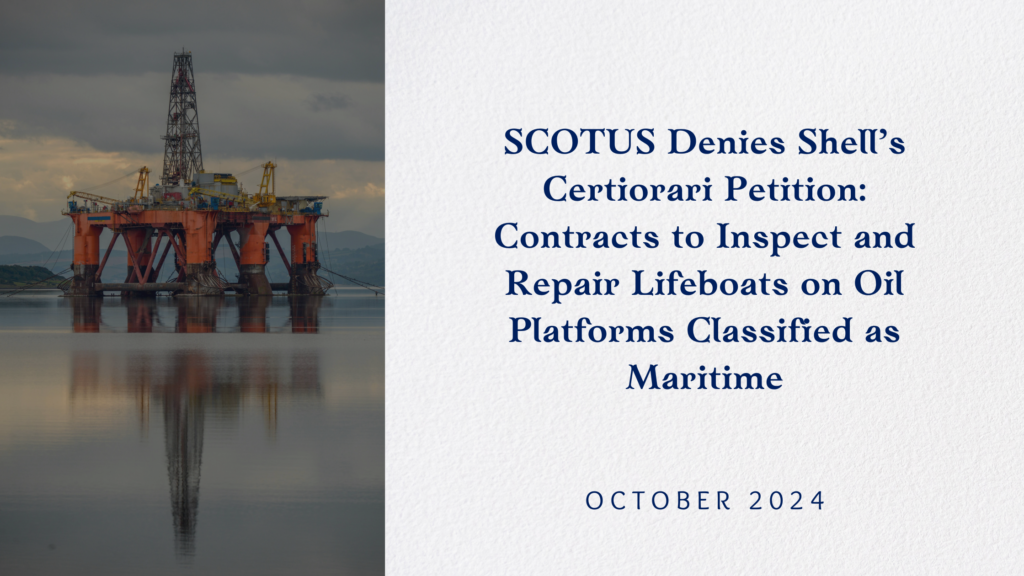
On October 7, 2024, the U.S. Supreme Court denied Shell’s certiorari petition to review the Fifth Circuit’s decision, which held that a contract to inspect and repair lifeboats on an oil platform located on the Outer Continental Shelf is a maritime contract. Earnest v. Palfinger Marine USA, Inc., 90 F.4th 804 (5th Cir. 2024).
Saving to Suitors Clause: Understanding the Fundamentals
Under the jurisdictional statute, 28 U.S.C. § 1333(1), federal courts are granted “exclusive” jurisdiction over maritime claims. At the same time, the saving to suitors clause preserves the concurrent jurisdiction of state and federal courts. How to reconcile this conflict? Are there any other conflicts related to the saving to suitors clause? These questions are explored in this article.