
Welcome to this selection of admiralty and maritime law updates for July and August 2026. This summer season has been remarkably productive for the courts: they have handed down rulings in some of the most noteworthy maritime cases, including those arising from the M/V Dali’s allision with the Francis Scott Key Bridge in Baltimore, Maryland, and the planned auction of artifacts recovered from the Titanic. The U.S. courts also returned to the Limitation of Liability Act of 1851, raising novel questions and testing its boundaries: whether a small commercial vessel enjoys the Act’s protections, and what sums make up the limitation fund. Below are summaries of these and other maritime decisions.
Fifth Circuit Clarifies When a Small Vessel Loses the Right to Limit Liability
In re M/V MS Adalyn, No. 25-20584, 2026 WL 2364283 (5th Cir. Aug. 14, 2026)
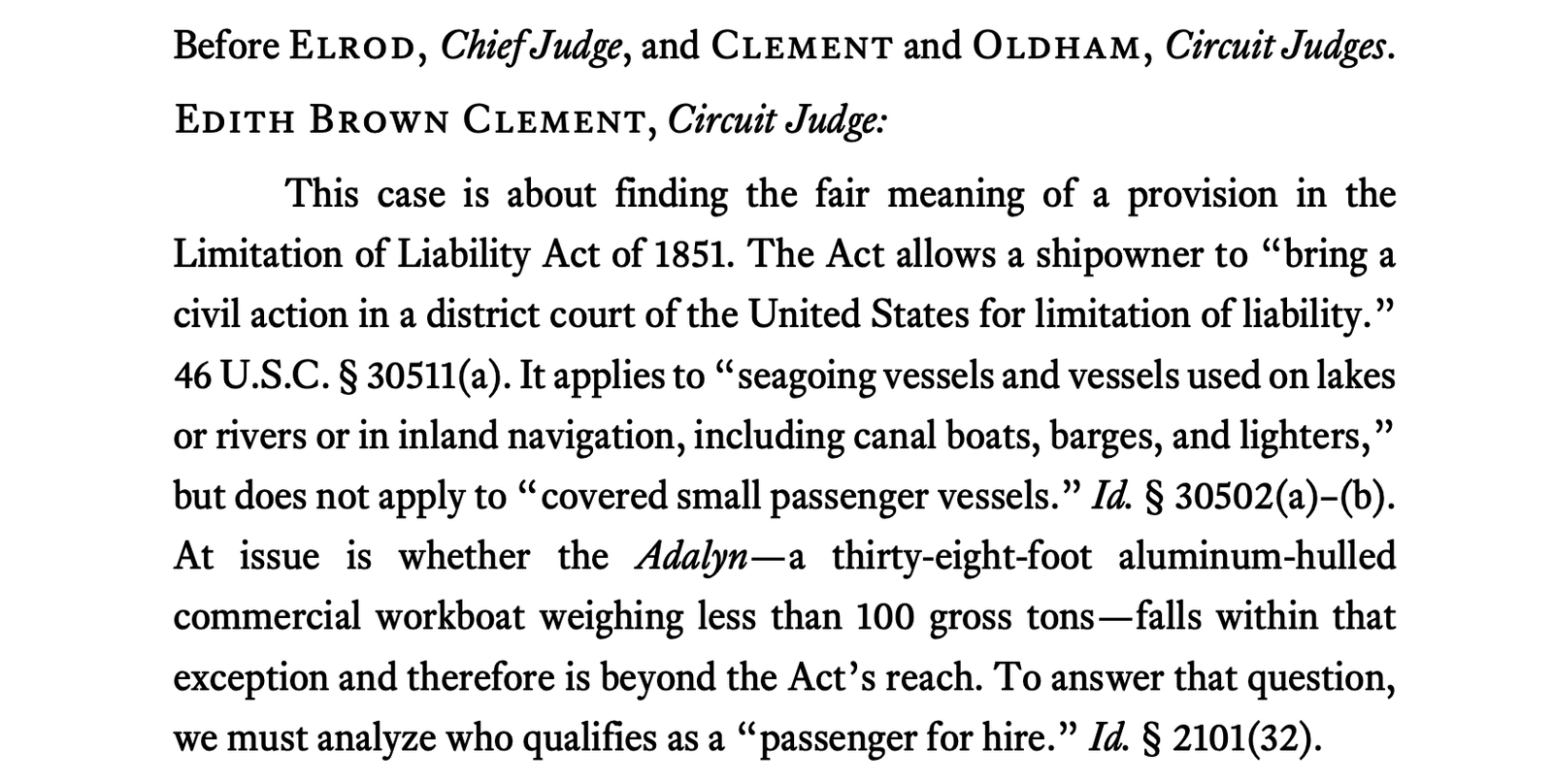
The Limitation of Liability Act of 1851 allows a shipowner to limit its liability at the value of the vessel and pending freight, but that protection is not available to every vessel. It does not extend to “covered small passenger vessels.” The case turns on whether the Adalyn qualifies as a “covered small passenger vessel” and is therefore excluded from the protections of the Limitation of Liability Act.
The Adalyn, a thirty-eight-foot, aluminum-hulled commercial workboat of less than 100 gross tons, was provided by Hunter Marine Group, LLC (“Hunter Marine”), her bareboat charterer, to Encore Dredging Partners, LLC (“Encore”) under a contractor agreement. While Encore was using the Adalyn for maintenance dredging on the Alabama River, she ran aground and struck a steel pipe. Eight Encore employees aboard were injured.
After the workers sued, Hunter Marine and the owner petitioned for limitation of liability. The district court held the Adalynwas a “covered small passenger vessel” excluded from the protections of the Limitation of Liability Act. The U.S. Court of Appeals for the Fifth Circuit affirmed.
The disposition turned on the definition of “covered small passenger vessel,” which the Act excludes from limitation. 46 U.S.C. § 30502(b). A “covered small passenger vessel” must first be a “small passenger vessel,” id. § 30501(1)(A), and the relevant branch of that definition is “a vessel of less than 100 gross tons … carrying more than 6 passengers, including at least one passenger for hire,” id. § 2101(49)(A). The Adalyn satisfied the tonnage requirement, so the case reduced to a single question: did she carry “more than 6 passengers, including at least one passenger for hire”? That, in turn, depended on how “passenger” and “passenger for hire” are defined.
A “passenger” is “an individual carried on the vessel,” but crew are excluded if several conditions are met, including that the person “has not contributed consideration for carriage.” 46 U.S.C. § 2101(31)(A)(iii). Accordingly, a crewmember who has contributed consideration falls outside the exclusion and may qualify as a passenger. “Passenger for hire,” in turn, means “a passenger for whom consideration is contributed as a condition of carriage on the vessel, whether directly or indirectly flowing to the owner, charterer, operator, agent, or any other person having an interest in the vessel.” 46 U.S.C. § 2101(32). Reading these provisions together, the Fifth Circuit held that it does not matter who supplies the consideration, the crewmember personally or his employer. Because Encore paid Hunter Marine to use the Adalyn, including to carry Encore’s employees aboard, the crewmembers indirectly contributed consideration for their carriage. They were therefore “passengers for hire,” the Adalyn was a “covered small passenger vessel,” and the Act’s limitation of liability did not apply.
Takeaways: When workers are carried aboard a small commercial vessel and their employer pays for her use, that payment likely makes them “passengers for hire.” If the vessel is under 100 gross tons and carries more than six such workers, she falls outside the Limitation of Liability Act. Owners and charterers should account for that liability exposure rather than assume the Act will cap it.
A thought to leave you with: the exclusion here turned on the vessel carrying “more than 6 passengers.” What if the Adalyn had carried six or fewer? She arguably would not have been a “covered small passenger vessel,” and limitation might have been back on the table. That raises an interesting question: for vessels like the Adalyn, is the real dividing line simply how many people are aboard?
Read the court’s opinion here.
P.S. This opinion is worth reading not only to track the judge’s reasoning in statutory interpretation, but also to see a fine example of how to open an opinion. Before the facts, Judge Clement names the question in one clean paragraph. Simple, clear, and it pulls you right in.
No Voyage, but Still “Pending Freight”? Federal Court in Massachusetts Holds That Earnings from a Demolition Contract Belong in the Limitation Fund
In re ACK Marine Equipment Rentals, LLC, No. CV 26-11073-WGY, 2026 WL 2198739 (D. Mass. July 30, 2026)
As noted above, the Limitation of Liability Act caps a shipowner’s liability at the value of the vessel and pending freight. This case raises a question the court called novel: whether the earnings a vessel makes from stationary work, rather than a voyage, count as “pending freight” under the Limitation of Liability Act and thus enlarge the fund that caps a shipowner’s liability. The court answered yes.
ACK 185 is a barge with a crane affixed to it, used for demolition work rather than for carrying cargo or passengers. On October 24, 2025, the crane’s boom fell onto an adjacent pier and crushed two ACK employees, who died. After their estates’ representatives filed a wrongful-death action in state court, ACK petitioned in the U.S. District Court for the District of Massachusetts for exoneration from or limitation of liability under the Limitation of Liability Act, depositing an interim stipulation of $1,200,500, of which it said $1,200,000 reflected the barge’s post-incident value, with “no pending freight.”
The representatives filed a motion for due appraisement under Supplemental Rule F(7), arguing the fund was too low because ACK had left out both the value of the crane attached to the barge and the value of the demolition contract the crane and vessel were performing at the time of the accident. Both sides agreed the value of the crane should be added to the fund. The live dispute was whether the earnings from the demolition project were included in the definition of “pending freight.”
The court granted the motion, holding that the earnings from the demolition contract count as “pending freight.” Neither the statute nor the rule defines the term, so the court read it against three sources. First, the dictionaries: Black’s and Webster’s define “freight” broadly as compensation paid for the use of a ship, and none makes a voyage a condition. Second, congressional intent: the court noted the Limitation of Liability Act was passed in 1851 to encourage shipping, yet ACK was not engaged in either shipping of goods or shipbuilding. Third, adjacent case law: the court leaned on the Supreme Court’s The Main v. Williams, which refused to read “freight pending” narrowly and defined it as “all rewards, hire, or compensation, paid for the use of ships.” ACK argued The Main required a voyage, but the court disagreed: the ship there simply happened to be on a passenger voyage, and the decision never made voyaging a condition of the term. The court also found support in other decisions, where courts had counted the earnings from a dredging contract as part of the fund. The Carson, 104 F.2d 762 (9th Cir. 1939); Great Lakes Dredge & Dock Co., LLC v. Puerto Rico Electric Power Authority, No. CIV. CCB-14-1450, 2015 WL 3796068 (D. Md. June 16, 2015).
Takeaways: For limitation purposes, “pending freight” is not confined to the earnings of a voyage. On this court’s reasoning, the compensation a vessel earns while performing stationary work, here a barge-mounted crane doing demolition, is part of the value an owner must bring into the fund. The practical significance is that a barge owner who deposits only the vessel’s post-casualty value and reports “no pending freight” may find the fund substantially enlarged by the value of the contract the vessel was performing when the casualty occurred.
Two cautions temper how far the decision travels. First, it is a district court ruling on an issue the court itself called novel, with no First Circuit or Supreme Court holding squarely on point, so its persuasive weight is modest. Second, the ruling turns on the meaning of “pending freight,” not on ACK’s entitlement to limit its liability, which is a separate question the order does not resolve.
Read the court’s memorandum and order here.
The M/V Dali and the Key Bridge: Federal Court in Maryland Applies Robins Dry Dock to Dismiss Most Economic-Loss Claims
In re Grace Ocean Private Ltd., No. CV 24-0941-JKB, 2026 WL 2482018 (D. Md. Aug. 25, 2026)
This is one of the central rulings in the limitation litigation arising from the March 2024 allision of the M/V Dali with the Francis Scott Key Bridge in Baltimore. After the wrongful-death, personal-injury, property-damage, and cargo claims settled, the only claims left in the limitation action were those of two local governments (the City and the County of Baltimore) and a group of businesses and individuals referred to as the Private Economic Loss (“PEL”) Claimants. The petitioners, the Dali’s owner Grace Ocean Private Limited and manager Synergy Marine Pte Ltd, moved for judgment on the pleadings, arguing that the economic-loss rule of Robins Dry Dock & Repair Co. v. Flint, 275 U.S. 303 (1927), barred all the remaining claims because none of these claimants owned property that was physically damaged in the allision.
The court granted the motion in part and denied it in part. Under Robins Dry Dock, a maritime tort claimant cannot recover purely economic losses flowing from damage to property in which it holds no proprietary interest. Applying this rule, the court narrowed each claim to the damages tied to the claimant’s own physically damaged property and dismissed everything else. The City may pursue its claim for damage to its 72-inch water main, which it plausibly alleges was harmed in the allision. This is physical damage to property the City owns, so Robins Dry Dock does not bar it. The City’s larger claims—for damage to city streets from diverted heavy traffic, lost tax revenue, and others—were dismissed as either purely economic or, though “physical,” too remote: the allision did not physically cause the street damage, and a long causal chain ending in some physical harm does not make that harm the kind Robins Dry Dock permits. The County’s claim survives only for physical damage to waterways and shorelines it can prove it owns. The PEL Claimants’ claims were dismissed almost entirely, with one exception: four “Container Claimants” who appear to allege that cargo they had aboard the Dali was physically damaged in the allision may continue pursuing their claims for that damage, if any.
Takeaway: The decision is a striking example of Robins Dry Dock in action. It is worth reading in full for the range of creative workarounds the claimants advanced and how the court engaged with each before rejecting it. The analysis rewards closer study than a summary of this length allows. Whether it survives on appeal, if one is taken, remains to be seen.
Read the court’s memorandum here.
Federal Court in Pennsylvania Dismisses the Suit Against the M/V Dali’s Shipbuilder on Forum Non Conveniens Grounds
Grace Ocean Private Ltd. v. Hyundai Heavy Industries Co., Ltd., No. CV 25-4374, 2026 WL 2226022 (E.D. Pa. Aug. 3, 2026)
This case is one of the legal proceedings arising from the March 2024 allision of the M/V Daliwith the Francis Scott Key Bridge in Baltimore. Here, the vessel’s owner, Grace Ocean Private Limited (“Grace Ocean”), and her manager and operator, Synergy Marine Pte Ltd (“Synergy Marine”), sought to pursue the shipbuilder in a U.S. court.
Hyundai Heavy Industries Co., Ltd. (“HHI”) built the M/V Dali in South Korea and delivered it in 2015 to its first owner. The construction contract, as well as a later 2021 settlement agreement between HHI and the vessel’s eventual owner, Grace Ocean, contained a clause referring any dispute to arbitration in London under English law. In March 2024, the Dali lost power leaving the Port of Baltimore and struck the Francis Scott Key Bridge. Grace Ocean (the owner) and Synergy Marine (the manager and operator) later sued HHI in the U.S. District Court for the Eastern District of Pennsylvania, grounding jurisdiction on HHI’s registration as a foreign corporation in Pennsylvania. HHI moved to dismiss for lack of personal jurisdiction or, alternatively, on forum non conveniens grounds.
The court held it had personal jurisdiction but dismissed the case on forum non conveniens grounds. On jurisdiction, it relied on Mallory v. Norfolk Southern Railway Co., 600 U.S. 122 (2023), which upheld Pennsylvania’s jurisdiction-by-registration statute: by registering as a foreign corporation and appointing an in-state agent, HHI consented to general jurisdiction on any claim. The court, however, dismissed the action on forum non conveniens grounds. It found each element of the forum non conveniens analysis satisfied: (1) London was an adequate alternative forum; (2) the private-interest factors weighed entirely for that forum due to the existence of a valid forum-selection clause in the settlement agreement; and (3) the public-interest factors did not save the suit, since HHI addressed them and the plaintiffs waived them by failing to. Synergy Marine disputed that it was bound by the forum-selection clause in the settlement agreement, since only HHI and Grace Ocean were named in the body of the agreement and it had signed merely as a witness. The court disagreed: all three signed in the same place under the same prefatory language, and Synergy Marine operated with Grace Ocean as a unit, so it too was bound.
Takeaway: Establishing jurisdiction is only half the battle. Even with personal jurisdiction over a foreign defendant, a U.S. court can dismiss based on forum non conveniens, which requires an adequate alternative forum and private- and public-interest factors weighing heavily in favor of dismissal. All three lined up here: London was an adequate forum, a valid forum-selection clause drove the private-interest factors toward it, and the plaintiffs left the public-interest factors unaddressed. Together, that was enough to send the dispute abroad despite a valid basis for jurisdiction in a U.S. court.
Read the court’s memorandum here.
Titanic Artifacts Bound for Auction? Not Without the Court’s Approval, Federal Court in Virginia Holds
R.M.S. Titanic, Inc. v. The Wrecked and Abandoned Vessel, No. 2:93-CV-902, 2026 WL 2475327 (E.D. Va. Aug. 24, 2026)
This is the latest ruling in the salvage litigation over the wreck of the R.M.S. Titanic. R.M.S. Titanic, Inc. (RMST) is the court-appointed salvor-in-possession. In 2011, the court granted RMST title to the artifacts from the R.M.S. Titanic recovered in its 1993 to 2004 expeditions (the “American Collection”), but only subject to the Covenants and Conditions imposed as a condition of the award. The court explained that the Covenants and Conditions are not a contract between RMST, the United States, and the court; rather, they are “a creature of maritime law and the court’s power, exercising in rem jurisdiction, to fashion an award for salvage of historic shipwrecks.” Those covenants make RMST the trustee of the artifacts for the public interest, require the collection to be kept together and intact in perpetuity, and command that it be conserved and curated together with the separately recovered 1987 “French Collection” as an integral whole. The United States, specifically the National Oceanic and Atmospheric Administration (“NOAA”), is the intended beneficiary of the Covenants and Conditions and is authorized to enforce them.
In March 2026, RMST notified the court that it planned to auction certain French Collection artifacts, citing financial difficulties. It argued that the court had no jurisdiction over the French Collection, since RMST had recovered and sent those artifacts to France in 1987, before it initiated this action and before the court assumed constructive in rem jurisdiction over the wreck, and that the Covenants and Conditions did not restrict sale of French Collection pieces. The United States, acting through NOAA, opposed the auction, arguing that it presents a material default under the Covenants and Conditions.
The court held that RMST’s planned auction is subject to its jurisdiction and approval and left it enjoined, pending further proceedings. The court explained that, by acceding to the Covenants and Conditions, RMST had accepted enforceable restrictions concerning the French Collection. The document requires that the American Collection be conserved and curated together with the French Collection as an integral whole, so a piecemeal sale and dispersal of French pieces would implicate the integrity of the American Collection, which is squarely within the court’s jurisdiction. The court, however, did not reach a final ruling, finding the record too thin to determine whether the auction is a material default. It ordered RMST to produce an inventory of the entire Titanic Collections, with proof that the items to be auctioned belong to the French Collection and that the American Collection remains intact, after which NOAA may submit a report and recommendation. After considering RMST’s inventory, any report and recommendation by NOAA, and any other relevant factual considerations that may arise, the court may hold an evidentiary hearing and issue a final determination as to whether the auction poses a material default. The auction remains enjoined pending these proceedings.
Read the court’s opinion and order here.
A Fixed-Price Wreck-Removal Contract Can Cover Minor Oil-Spill Cleanup Too, Barring a Separate OPA Recovery, Federal Court in New York Holds
Nautical Assist, Inc. v. Allan, No. 17-CV-5435 (ENV) (ARL), 2026 WL 2279894 (E.D.N.Y. Aug. 5, 2026)
In August 2016, a fire at a marina on Long Island destroyed Michael Allan’s forty-foot boat, the Allan’s Alley, along with six neighboring vessels. Nautical Assist, Inc., a company providing salvage assistance and other maritime services, removed the wreckage, contained and cleaned up the discharged fuel, and maintained a containment watch at the site. For the removal of the Allan’s Alley specifically, Nautical agreed a fixed price of $24,000 with a marine surveyor hired by Allan’s insurer, and that invoice was paid. Nautical later billed Allan hundreds of thousands of dollars more for environmental remediation. When Allan refused to pay, Nautical sued, pressing an Oil Pollution Act (“OPA”) claim against his estate and, alternatively, a breach-of-contract claim against the operator of the marina.
The court entered judgment for the defendants on both claims. On the OPA claim, it did not reach the question whether the estate was a “responsible party” under OPA because the issue was resolved by the interpretation of the oral wreck removal agreement between Nautical and the marine surveyor who represented Allan’s insurer. On uncontested expert testimony, the court found that in the maritime industry a “wreck removal” agreement customarily covers the cleanup of the small quantities of oil discharged by the wreck, at least where the spill is minor and the Coast Guard has not “federalized” a larger response. Here, only a marginal quantity of oil escaped, and the Coast Guard monitored but never directed a response beyond wreck removal and containment and removal of limited spill, so the court found the agreement covered both wreck removal and oil cleanup. Moreover, the $24,000 invoice carried no line-item detail. The court held that Nautical had already been compensated in full for its pollution remediation on Allan’s behalf and could recover nothing further against his estate.
On the alternative claim against the marina operator, which rested on the marina operator’s alleged oral promise to cover any shortfall left unpaid by the boatowners’ insurers, the court found the promise subject to an unmet condition precedent: the marina was to pay only to the extent Nautical could not recover from the boatowners’ insurers, and that had not yet occurred, since Nautical’s collection efforts were still ongoing. More fundamentally, the promise was not proven.
Takeaway: The case is a useful reminder that oral maritime contracts, while permitted, invite trouble when their scope is left vague. In this case, the lump-sum wreck removal price said nothing about oil cleanup, but the court read it, through industry custom, as covering both. Had the parties agreed in writing that wreck removal and oil-spill remediation were separate, separately paid services, Nautical’s position might well have been different.
Read the court’s memorandum and order here.
A Seaman’s Spouse Cannot Recover Loss-of-Consortium Damages for Non-Fatal Injuries, California Court of Appeal Holds
Simerley v. Golden Gate Bridge Highway and Transportation District, No. A173588, 2026 WL 2318560 (Cal. Ct. App. Aug. 11, 2026)
Tracy Simerley was injured while working as a seaman aboard a ferryboat owned by the Golden Gate Bridge Highway and Transportation District. In March 2025, he and his wife, Lynette, sued the District. Among their claims, Lynette brought one for loss of consortium, based on the claim that the vessel was unseaworthy and caused Tracy’s injuries.
The District demurred (i.e., filed the state-court equivalent of a motion to dismiss) on the ground that loss of consortium is a non-pecuniary remedy unavailable to spouses of injured seamen under either the Jones Act or general maritime law. The trial court sustained the demurrer without leave to amend, which suggests it saw the defect as purely legal and incurable by repleading. Lynette appealed.
The Court of Appeal affirmed, holding that a seaman’s spouse cannot recover loss-of-consortium damages for non-fatal injuries under either the Jones Act or general maritime law.
On the Jones Act question, the court held that the statute’s plain language forecloses loss of consortium for non-fatal injuries. The Act allows “[a] seaman injured in the course of employment” or, if the seaman dies, his personal representative to bring a civil action against the employer. 46 U.S.C. § 30104(a). Thus, where the seaman is injured but survives, the Act authorizes no one but the seaman himself to sue, which necessarily excludes a spouse’s consortium claim.
On the general maritime law question, the court applied the framework the U.S. Supreme Court built across Miles v. Apex Marine Corp., Atlantic Sounding Co. v. Townsend, and The Dutra Group v. Batterton. Under that framework, a remedy is available under general maritime law only where (1) it was traditionally available for the claim involved, and (2) allowing it preserves uniformity with the parallel statutory scheme, with a residual inquiry into (3) whether policy grounds compel the remedy. On the first factor, the court found no historical tradition of awarding loss of consortium for injuries caused by an unseaworthy vessel. Lynette relied on a 2018 district court decision, Morgan v. Almars Outboards, Inc., 316 F. Supp. 3d 828 (D. Del. 2018), for the claim that loss of consortium had long been available in maritime cases. But the court found the older decisions Morgan rested on unavailing. Some sounded in negligence rather than unseaworthiness, others involved longshoremen rather than seamen, and one case did not rest on general maritime law at all. Individually and together, they fell short of the clear historical pattern Batterton requires. On the second factor, the court concluded that since the Jones Act bars loss of consortium for non-fatal injuries, allowing it under general maritime law would break the uniformity with the federal statutory scheme. And on the third factor, Lynette offered no policy ground to justify the remedy.
Takeaways: After Batterton, a plaintiff seeking a remedy under general maritime law must show it was historically available for the specific claim pleaded. For spouses of injured seamen, no such record exists for loss of consortium on an unseaworthiness theory, so the claim fails under both the statute and the general maritime law.
Two further points are worth noting. First, the holding is tied to the unseaworthiness claim Lynette pursued, and its reasoning is specific to that cause of action. A consortium claim based on negligence rather than unseaworthiness, or arising from a seaman’s death rather than injury, would need to be analyzed on their own terms.
Second, the case is a tidy illustration of the saving-to-suitors clause in operation: a seaman’s spouse litigated a federal maritime question in state court, and the California Court of Appeal applied federal maritime law, treating U.S. Supreme Court maritime precedent as binding and lower federal court decisions as persuasive authority.
Read the court’s opinion here.
Can You Ignore a Federal Court Judgment and Challenge It as Void Years Later With No Good Reason for the Delay? First Circuit Says No
Flaherty v. Amigos Del Mar Ltd., 180 F.4th 396 (1st Cir. 2026)
Susan Flaherty was severely injured during a May 2019 scuba trip in Belize when an employee of the dive operator, Amigos Del Mar Ltd., pushed her off the company’s boat and she was pulled into its engaged propellers. She sued Amigos in the U.S. District Court for the District of Massachusetts in August 2020, alleging subject matter jurisdiction under 28 U.S.C. § 1333, and served the Belizean company under the Hague Service Convention. Amigos’ controlling shareholder signed the proof of service, but the company never appeared. In June 2021, the court entered a default judgment against Amigos, and in February 2022, after an evidentiary hearing, it entered an amended judgment awarding Flaherty more than six million dollars in damages, plus interest.
Flaherty then sought to enforce the judgment in Belize, serving Amigos with Belizean process in July 2022 and obtaining an enforcement order there. Only in February 2024, two years after the U.S. judgment and nineteen months after Flaherty sought enforcement in Belize, did Amigos first appear in the Massachusetts action, moving to vacate the default judgment under Rule 60(b)(4) as void for lack of personal and subject matter jurisdiction. The district court denied the motion, and Amigos appealed.
The U.S. Court of Appeals for the First Circuit affirmed without reaching the jurisdictional merits, resting instead on the timing gatekeeper in Rule 60(c)(1), which requires every Rule 60(b) motion to be made “within a reasonable time.” The court acknowledged that its own prior rule had exempted void-judgment motions under Rule 60(b)(4) from any time limit, but while this appeal was pending, the Supreme Court held in Coney Island Auto Parts Unlimited, Inc. v. Burton that a 60(b)(4) movant must comply with 60(c)(1) and file within a reasonable time. The court declined to set a bright-line deadline or tie reasonableness to any single factual showing, assessing instead the length of the delay, its justification, and any prejudice from granting relief.
Applying that rule, the court found Amigos’ delay unreasonable on two grounds. First, the length: circuit precedent had called a sixteen-month delay “overlong in virtually any event,” and Amigos had waited longer. Second, the justification: Amigos’ claim that counsel had advised it not to appear, believing the U.S. courts lacked jurisdiction, held no weight, since disagreement with a court’s jurisdictional finding is no justification to ignore it. As for prejudice to Flaherty, the parties disputed it, but the court found it unnecessary to resolve: even assuming prejudice was minimal, it did not change the result, since prejudice is only one part of the analysis and “not the lodestar.”
Takeaway: The rule here is not maritime-specific, but it is important for maritime practitioners involved in federal litigation. After Coney Island Auto Parts, no federal civil defendant can use Rule 60(b)(4)’s “void judgment” theory to buy unlimited time. Flaherty brings the First Circuit into line with that rule, ending its prior “at any time” approach. The consequence bites hardest in international disputes like this one: a foreign defendant served abroad under the Hague Convention who defaults in a U.S. action, betting the judgment can later be attacked as jurisdictionally void, is now on the clock. The challenge must come within a reasonable time. A long delay without a plausible justification may be fatal regardless of how strong the jurisdictional argument is.
Read the court’s opinion here.
Loss of Bargain Damages Are Recoverable Under Clause 14 of the Norwegian Saleform 2012 Even Without a Repudiatory Breach, UK Supreme Court Holds
Great Asia Maritime Limited v Orion Shipping and Trading LLC [2026] UKSC 23
This appeal concerns clause 14 of the 2012 version of the Norwegian Saleform (“NSF”), which has long been the standard form commonly used for sales of second-hand ships. Clause 14, headed “Sellers’ default,” allows the buyers to cancel the agreement if the sellers fail to give notice of readiness or to be ready to complete the transfer by the cancelling date. It also requires the sellers to make “due compensation” for the buyers’ “loss and for all expenses” where the failure is due to “proven negligence,” whether or not the buyers cancel.
The sellers agreed to sell the M/V Lila Lisbon for US$15 million. They negligently failed to deliver by the cancelling date, and the buyers cancelled. By then the market had risen and an equivalent vessel was worth US$16.85 million. The arbitrators awarded the buyers US$1.85 million in loss of bargain damages, the difference between the contract and market prices. The Commercial Court reversed, holding that clause 14 allowed recovery only for losses crystallized at the point of cancellation, such as “expenses incurred by the buyers in making arrangements to crew the vessel, carrying out inspections, legal costs and preparing for delivery generally,” but not loss of bargain in the absence of a repudiatory breach. The Court of Appeal restored the award, and the sellers appealed.
The UK Supreme Court dismissed the appeal, holding that clause 14 entitles the buyers to loss of bargain damages even without a repudiatory breach. The Court noted that the word “loss” in clause 14 is general and unqualified, and that loss of bargain is the most obvious loss a buyer suffers on cancellation. That interpretation was reinforced by three factors. First, clause 13, the parallel “Buyers’ default” clause, uses materially the same wording, and Court of Appeal authority had treated it as allowing sellers to recover loss of bargain damages, so clause 14 should be read the same way. Second, a buyer who cancels for non-delivery is in much the same position as a buyer under a sale of goods contract, where the normal measure of damages is the difference between the contract and market prices under the Sale of Goods Act 1979. Third, and most powerfully, loss of bargain damages have been recognized as recoverable under clause 14 since Staughton J’s 1981 decision in The Solholt. That established meaning of a standard-form term is one the courts are reluctant to disturb, since parties rely on the settled construction of such terms.
Read the UK Supreme Court’s judgment here.
This concludes the selection of admiralty and maritime law updates for July and August 2026. Thank you for reading, and see you next month! ⛵
The information provided in this article is intended for informational purposes only and does not constitute legal advice. It should not be relied upon or applied without consulting an attorney to address your specific circumstances. Please note that this article was published on the date indicated and may not reflect subsequent changes in the law.